


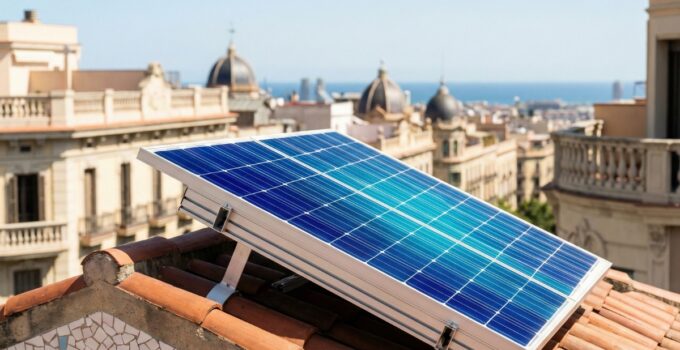
Reducing the lighting bill and investing in sustainability is much easier if it is done as a team. Discover how to install solar panels in the community of Veïns I began to work collectively this year 2026.
The most important of this article:
- With the simple majority of the votes to the board It is sufficient to approve the installation of solar panels in the community of Veïns; Cap person can block it alone.
- Thewas in the electricity bills to the common areas and for individuals to access the 40% to 80%, amb una Amortization of the investment in just 4 or 7 years in large buildings with more than 50 habitats.
- He I saw that you vote against, you don't pay for the installation, but they also do not benefit from the energy that is generated; pot adherir-s'hi més endavant pagant la seva part proportional.
- Solar panels increase the value of the teu pis between a 6% and a 18% in improving the Energy Efficiency Certificate of the building and its habitat.
- Combine IBI subsidies, Next Gen funds and IRPF deductions pot cobrir fins al 60% of the total cost of the installation.
In this article you will learn:
- Is it profitable to install solar panels in the community of residents?
- Modalities of installation: Who is most suitable for the community?
- Regulations: Horizontal Property Law and if they are denied
- How much will the installation cost without subsidies for solar panels in neighboring communities in 2026?
- Subsidies and aid available in 2026
- How to install solar panels in the community of Veïns in 5 steps?
- Problems with solar panels in the community of residents and with resolders
- What is the impact of solar panels on the community of residents or on the value of an individual property?
Is it profitable to install solar panels in the community of residents?
Yes, you go to the common areas to reach 80%, the investment is recovered in 4-12 years depending on the size of the building, and the panels continue to generate benefits for 15 years more.
The answer is yes, and the numbers confirm it. Segons informs the “holaluz” portal”, if it is decided to install solar panels in the community of Veïns, The annual payment to the electric bill of the common areas can be added from 40% to 80% in extreme cases.
| Tipus d'estalvi | Annual estimate | Typical profile |
|---|---|---|
| Només common areas | €800–2,000 | Building of 10 to 20 habitatges |
| Collective self-consumption (BASIC) | €2,500–5,000 | Building of 20 or more homes + proportional distribution |
| Collective self-consumption (optimal) | €5,000–9,000 | Building of 40 or more homes, high daytime demand |
He termination of the amortization of the installation of solar panels to the community of Veïns, That is to say, the time it takes to recover the investment complexes an inversely proportional rule.
Depèn principalment de la measurement of the installation and subsidies for solar panels in communities of neighbors you obtain:
- Buildings petits (up to 10 habitats): 8–12 years
- Buildings media (10–25 habitatges): 6–9 years
- Buildings great (more than 25 dwellings): 4–7 years
With a useful life of the panels of 25 to 30 years, finally in the most conservative scenario the installation generates net profit for more than 15 years after amortization.

Modalities of installation: Who is most suitable for the community?
Hi there are 3 options; only common areas (the simplest), collective self-consumption (direct payment to the bill for each vehicle) or private areas for one owner; The 3 are used by the simple majority.
Existeixen 3 different ways to install solar panels in the neighborhood of Veïns The choice conditions both the cost and the subsequent management.
- Common areas: Els panells abasteixen exclusively the shared services (elevator, lighting, garage, computer room...); It is the most technically and legally simple option. It does not require modification of individual supply contracts.
- Collective self-consumption: L'energia produïda It is distributed among the participating habitats according to distribution coefficients agreed upon by the board. Each time the individual bill is reduced. Requires more processing from the distributor.
- The privacy of the cover for a sun I saw: An owner installs and costs the panels for his or her exclusive use., ceding the common space of the cover. The community has to approve and may demand economic compensation or partial cessation of energy.
| Variables | Common areas | Collective self-consumption | Ús privatiu |
|---|---|---|---|
| Beneficiaries | Community | Tots els adherits | I saw a sun |
| He managed | Lower | Mitjana | Baixa per a la comunidadt |
| Estalvi per habitatge | Indirect (quota) | Direct to invoice | Cap (subtraction) |
| Initial cost | Baix-mitjà | Mitjà–alt | Ho assumeix el veí |
| Vots necessaris | simple majority | simple majority | simple majority |
Regulations: Horizontal Property Law and if they are denied
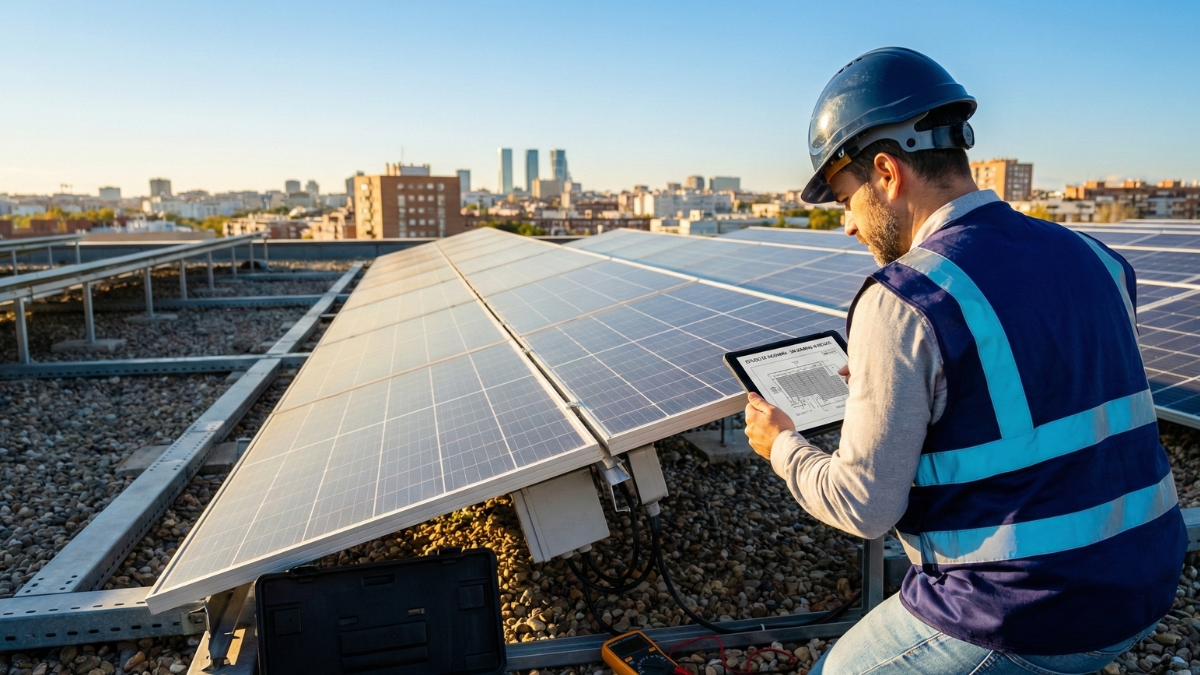
Since 2019, a simple majority is enough to approve the installation: the person who votes against does not pay the self-consumption part, but neither does he benefit, and he cannot block it if the majority decides to continue endavant.
The Horizontal Property Law (LPH), after the 2019 reform, It greatly facilitates the installation of renewable energies. For this reason, currently the regulations for the installation of solar panels in communities of veïns are here punts clau:
Votes, call and responsibilities
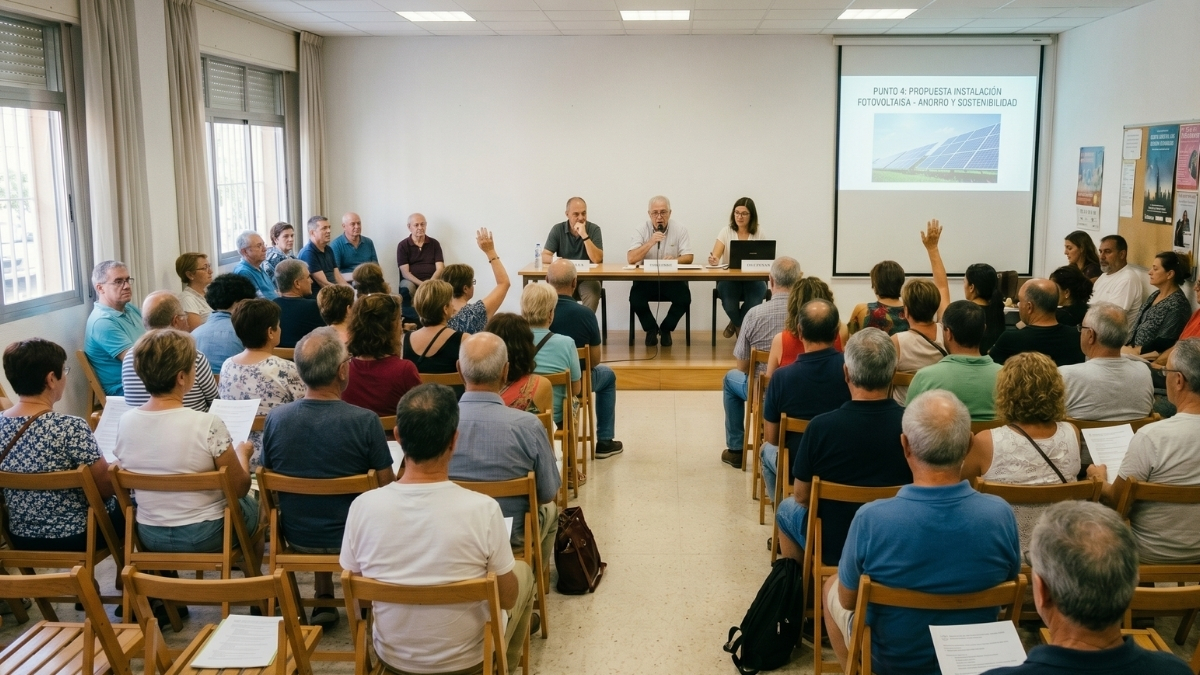
- The simple majority (more votes in favor than against, computing those present and representing the board) It is sufficient to approve a shared self-consumption installation.
- The point must appear on the order of the day of the call specifically: “Proposal for the installation of a photovoltaic self-consumption system with reading to the roof” — a generic wording to invalidate the agreement.
- He president of the community signs the contract with the installer and, in many cases, acts as a representative of the distributor and the public administration. If you delegate to the property administrator, it must be expressly stated in the meeting agreement.
- They The votes of those absent from the meeting add to the majority result If they do not express their disagreement in writing within the 30 days following the record.
What happens to those who vote against?
I saw that you voted against, or that you simply did not participate, tea drets clars, but also limits:
- No està obligat a pagar the part of the installation intended for collective self-consumption. Yes, it must contribute, in the proportional part that corresponds to it, to the common areas that the installation will benefit the entire community (for example, the lighting of the scale).
- You cannot block the installation if the majority approves it. The LPH expressly reclaimed the majority's drive to achieve greater energy efficiency.
- It does not benefit from the energy generated nor can you access self-consumer credits while you are not a member.
- Pot incorpora-se at any later moment, pay the proportional part of the current initial cost (generally with a small recovery for financing “deferit a posteriori”). The conditions of incorporation must be included in the meeting agreement itself.
Practical Council:
The installation of solar panels entails a demonstrable increase in the benefits of the Building Energy Efficiency Certificate. A better certificate, Going from the letter E or D to C or B, which can translate into an increase in the taxation value of each item between a 5% and a 15%. If you are thinking about selling your habitat, this is a factor that should be taken into consideration before voting against. Find out how much your home is worth with Housfy's free calculator If the installation of solar panels is finally approved in the community of Veïns, compare values.
How much will the installation cost without subsidies for solar panels in neighboring communities in 2026?
The installation without subsidies and aid costs between €8,400 and €70,000 depending on the size of the building applying for aid, divided between six per participation coefficient, equal parts or estimated consumption, which is decided by the board.
The cost of the installation varies depending on the kWp of power and other variables, com ara the measure of the building and the installation cost, remaining possible subsidies for solar panels in neighborhoods.
| Building size | Orientative power | Installation cost (sense of aids) | Cost of subsidies (approx. 30%) |
|---|---|---|---|
| 8–12 habitatges | 10–15 kWp | €12,000–18,000 | €8,400–12,600 |
| 13–25 habitatges | 15–30 kWp | €18,000–€35,000 | €12,600–24,500 |
| 26–50 habitatges | 30–60 kWp | €35,000–€65,000 | €24,500–€45,500 |
| More than 50 homes | 60–100 kWp | €65,000–100,000 | €45,500–€70,000 |
- Important note: The price per kWp installed in 2026 is between €900 and €1,400, according to the quality of the panels, the type of cover and the complexity of the accesses.
How does the distribution of groceries work between the veïns?
The cost It is usually distributed by one of these criteria., elect the board:
- Participation coefficient (the one that appears in the community statutes): it is the most common and the most equitable in installations of common areas.
- Name of habitats in equal parts: easier to calculate, since it penalizes small apartments.
- Energy distribution coefficient: proportional to the estimated consumption of each habitat, more precisely in collective self-consumption.

Expert Council:
They just voted for the board, demanding from the installer a feasibility study also includes two scenarios for the distribution of costs between the veïns. That each person pays in paper and how much he or she sends to his or her own bill to drastically reduce objections to the vote. The study can either be free or have a symbolic cost that is deducted from the final budget.
Subsidies and aid available in 2026
It is possible to combine the IBI bonus, Next Generation EU funds and personal income tax deductions, reaching between 30% and 60% of the total cost according to the autonomous community and the rental level of the building.
Combine various aids for the installation of solar panels to the community of Veïns It is very feasible today. These are some of the possible lines that our real estate experts recommend:
- IBI Bonus (ends of 50%): The town councils can apply a reduced the tax on Béns Immobles for a period of 3 and 5 years for properties with solar installation. Not all municipalities apply, but most of them apply to provincial capitals. Cal·tender-la to the council after the installation.
- Next Generation EU Fund: the program of energy rehabilitation of buildings (PREE 5000 and its successors) copper between a 30% and a 60% of the investment in communities with lower or middle ground. The procedure is managed through the autonomous community.
- Income tax deductions: The owners of habitual habitats can deduce the ends at a 20% of the investment in energy efficiency millions (state tram). The limit is €5,000 per taxpayer and any.
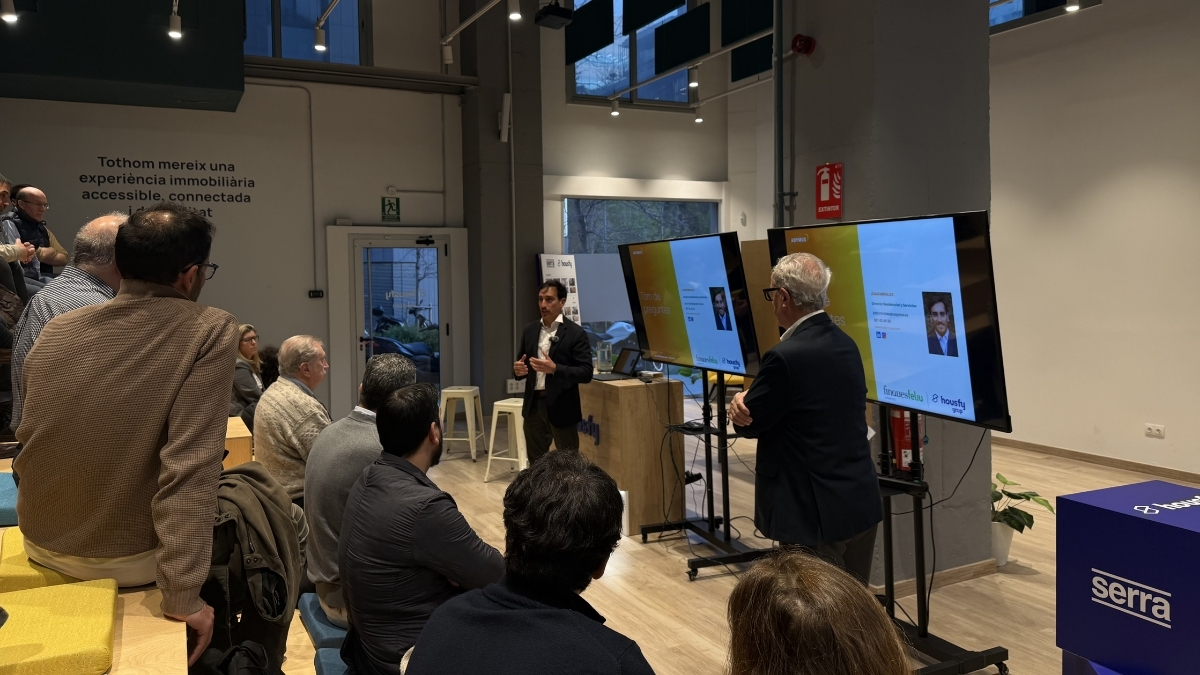
If you want know more about these aids, to Housfy we dedicate one of our events “d'Escola de Presidents” to the transition to solar energy.
How are these aid distributed by autonomous communities?
| Autonomous Community | Outstanding aid 2026 | indicative quantity |
|---|---|---|
| Catalonia | ICAEN – Renewable Energies | Fins al 40% del cost |
| Madrid | MIVAU call adapted | Fins al 35% del cost |
| Andalusia | PREE Autonomous Program | Fins al 40% del cost |
| Basque Country | EVE – Solar Energy | Fins al 45% del cost |
| Valencia | IVACE Energy | Fins al 35% del cost |
| Remaining Autonomous Communities | Next Gen Funds managed | 30–40% of the cost |
How to install solar panels in the community of Veïns in 5 steps?
Viability study, voting for the board, election of the installer, processing of permits and subsidies, and physical installation; The entire process lasts between 2 and 5 days of work with an approved cop.
According to our experts, the installation of solar panels in the community of Veïns can be divided into 5 simple steps which is shown below:
Step 1: Proposal and feasibility study
Qualsevol see or the administrator himself can initiate the process. It is recommended entrust a feasibility study to a certified installation company They just brought the assumption to the meeting to present real amounts of cost, maintenance and amortization.
Step 2: Call and vote for the board
El punt ha d'incloure's a The order of the day with precise wording. At the meeting I decided to also agree:
- The modality d'instal·lació
- He cost distribution criteria
- Them future accession conditions per als veïns who vote against
Step 3: Choice of installer and technical project
Amb l'acord of the meeting to the mà, it is requested almenys 3 budgets for certified installers (REE approval). The elegit prepares the technical project, necessary for the administrative procedures.
Step 4: Processing of permits and subsidies
They usual procedures are:
- Works license to the city council (in most municipalities it is prior communication, not license)
- Application for aid and subsidies in front of the Autonomous Community
- Notification to the distribution company (mandatory for collective self-consumption installations)
Step 5: Installation, connection to xarxa and configuration of distribution coefficients
The physical installation It will last between 2 and 5 days for a standard building. After connection to the system, the installer or an energy manager configures the distribution coefficients to the measurement system.
This “coefficient” is the percentages that determine what fraction of the energy generated is credited to the bill of each participating habitat. These coefficients can be modified by the board if circumstances change (new adhesions, changeovers).
- Important note: The costs generated by the solar panels do not just reduce the community quota, but rather It directly improves the financial capacity of each owner. If you are considering purchasing a home, remember that the monthly monthly allowance in the community influences the calculation of your debt capacity. With a solar installation, this weight can be reduced considerably. Use Housfy's mortgage simulator Per see how the mortgage would be tenint in compte aquest estalvi.
Problems with solar panels in the community of residents and with resolders
Cap veí can veto the installation, the defaulters are exempt from the distribution of energy, and the technical problems are covered by mandatory guarantee; hi has legal solution for every common obstacle.
| Problem | Solution recommended by Housfy experts |
|---|---|
| A vei blocks the voting | The LPH (Llei de Propietat Horitzontal) does not grant individual veto rights. If there is a tie, it is possible to call a second meeting or go to the judici d'equity. |
| The administrator does not promote the project | Qualsevol veí pot demand in writing that the topic was included in the order of the day. If the administrator refuses without cause, the board may formally request it. |
| Disputes over distribution coefficients | To propose a repartiment system based on historical consumption and voting criteria with a modification of the original agreement. |
| Morós que vol beneficios-se | While the debt persists in the community, it is excluded from the distribution of energy. The agreement of the board must foresee this situation expressly. |
| Post-installation technical problems | All certified installers are obligated to offer a minimum guarantee of 5 years on work and between 10 and 25 years on panels and inverters. This guarantee must be required in writing before signing the contract. |
What is the impact of solar panels on the community of residents or on the value of an individual property?
The impact of solar panels on the community of residents is always positive and is documented to increase the value of the individual properties of the building.
According to data from the sector, The properties with certification B or higher come between a 6% and a 18% more cars que els equivalents amb certificate D or lower.
Therefore, the solar installation contributes directly to improve the letter of the building's energy certificate, which allows access buyers with better finances and justify convertible prices and higher sales.
- Important note: If you own a rental accommodation in a building with solar installation, You have a concrete argument to review the rent to the alça; lowest energy efficiency of the tenant, highest certification and highest quality percebuda of the property These are factors that tenants value and why they are willing to pay more. Calculate the profitability of your rental home with Housfy's house I discover who benefits and can report the latest solar investment.
Frequently Asked Questions (FAQs)
How many votes do you have for installing solar panels in a community?
With the Horizontal Property Law reformed in 2019, enough with the simple majority The owners present and represent the board to approve a self-consumption installation.
Those absent who do not express disagreement in writing in 30 days join the majority.
How much do you spend per month on solar panels in a community?
Depending on the size of the installation and the mode chosen. In only common areas, the reduction of the community quota could be €20 to €80/month per habitatge.
In collective self-consumption, it is direct to the individual bill and can oscillate between €10 and €60/month according to the consumption and the coefficients assigned.